AI isn't just changing our tools. It is changing the very way we work.
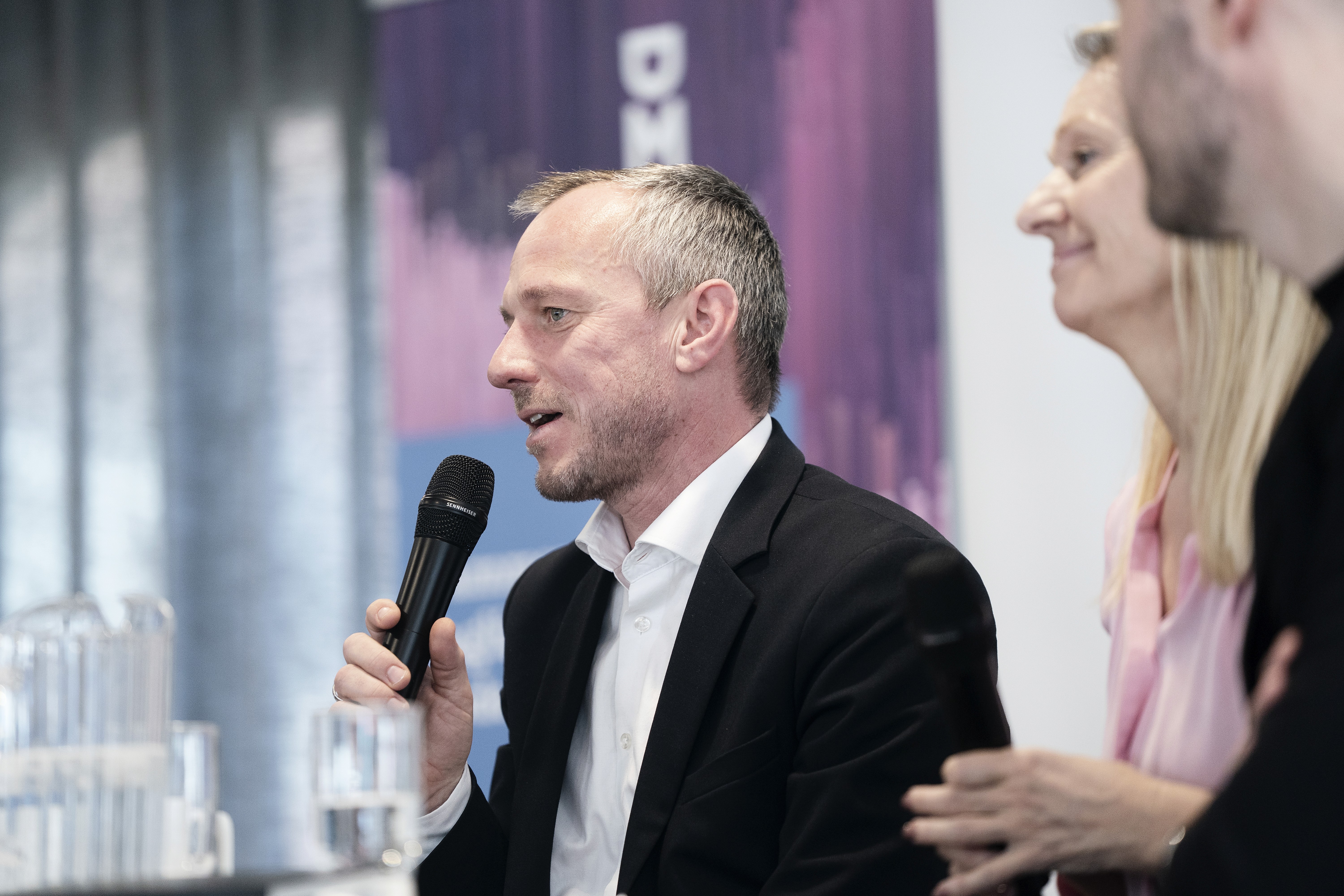
That was one of the main points when our Managing Director Jesper Nørding Pedersen participated in the panel debate "Which competencies do employers dream of?" at Digi:Talk 2026, organised by DM Digi.
Together with Mette Lundberg from the IT-Branchen and Martin Wood from the Court Administration (Domstolsstyrelsen), the panel discussed which competencies employers demand at a time when AI is rapidly moving into organisations' core processes.
At Forte Advice, we are already seeing the contours of a new type of workplace. A workplace where humans and digital agents work side by side. We call it Human + Agentic.
When AI becomes a colleague
In many organisations today, AI is used to streamline individual tasks. But the real gains only arise when you rethink workflows and processes from the ground up.
This requires that employees do not just use the technology. They must collaborate with it.
In a Human + Agentic organisation, employees work directly alongside digital agents that can automate analysis, development, and knowledge work. This frees up time for what humans do best. Strategic thinking. Creative problem solving. Relationships.
When technology is used correctly, it does not become a replacement for humans. It becomes an accelerator for their skills.
At Forte Advice, we have already integrated this approach into our way of working. This means, among other things, that our consultants work closely with digital tools and AI agents in analysis, strategy development, and creative production.
Employers' wish list for future employees
At the conference, DM Digi also presented a list of the competencies employers demand in the knowledge work of the future.
The list points to nine key competencies:
Analytical skills
Critical thinking
Adaptability
Understanding of security
Relational skills
Desire to experiment
Ability to learn new digital tools
Interdisciplinary understanding
These are competencies that clearly reflect a working world where technology does not stand alone, but functions in synergy with human judgement.
AI changes the demands on employers
The discussion at Digi:Talk also pointed to an important point. The responsibility for future skills lies not only with employees. It also lies with employers. Organisations must create environments where employees can learn, experiment, and develop new ways of working. This requires investments in technology, culture, and competence development.
As futurist Louise Fredbo-Nielsen pointed out during the conference, the World Economic Forum expects that 35 percent of the skills we have today will be irrelevant in five years.
This makes the ability to learn new things one of the most important competencies of all.
Technology is a choice
AI is often described as a force that hits organisations from the outside. But as Stine Lomborg, professor at the University of Copenhagen, emphasised at the conference, that is not the whole truth. We still have an influence on how the technology is used.
Organisations can choose whether AI should be used for pure efficiency. Or whether it should be used to create better decisions, stronger collaboration, and more valuable work.
At Forte Advice, we believe in the latter. That is why we work purposefully to develop organisations where technology and people interact in new ways.
Not because AI is the goal. But because the interaction between humans and technology can create better solutions for businesses, customers, and society alike.