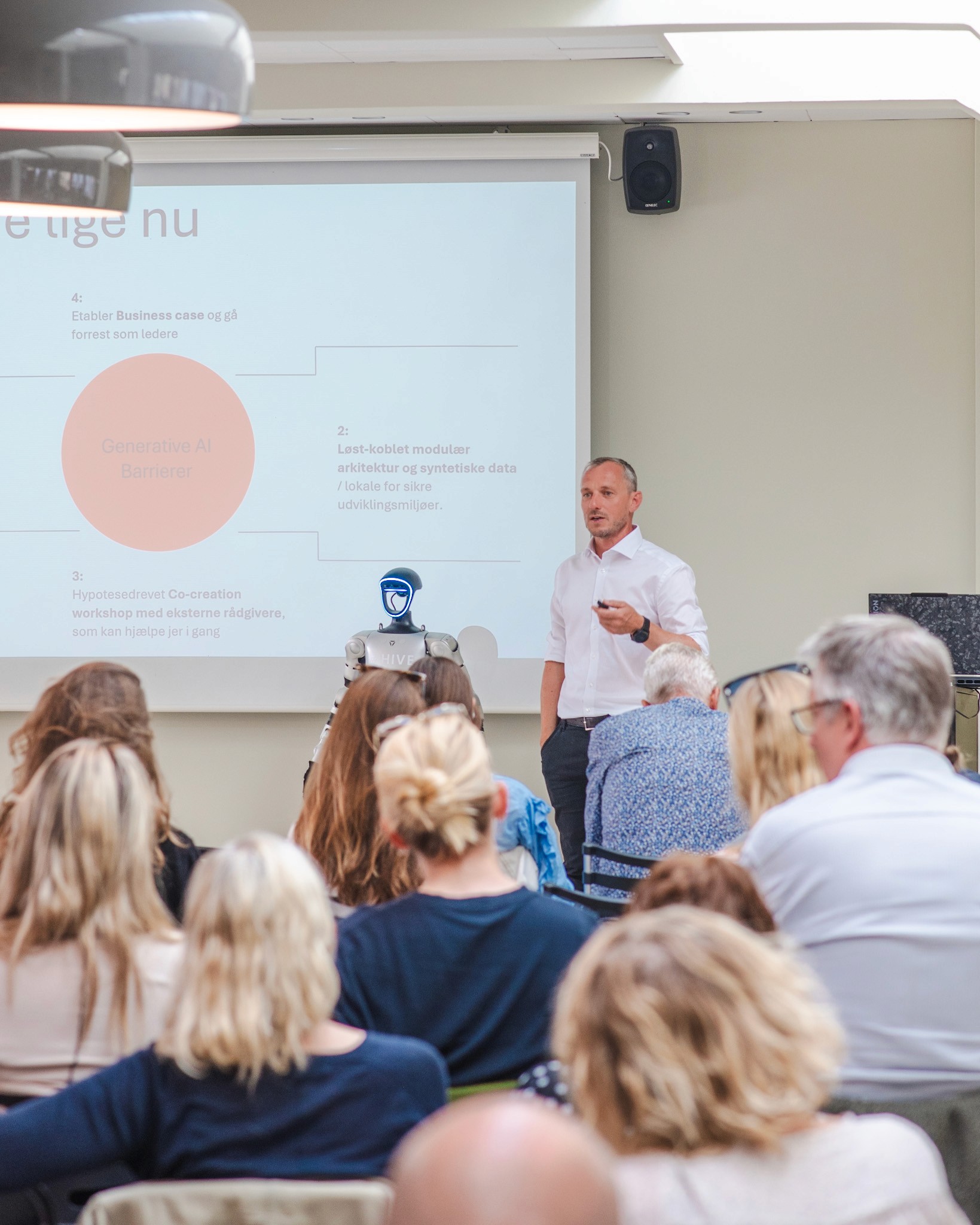

Jesper Nørding Pedersen is the Managing Director at Forte Advice, which is behind, among other things, the Cancer Society's smoking cessation app and the website of Copenhagen University College. According to him, tasks like these cannot be solved without generalists like humanities scholars.
You do not need a heavy digital knowledge to navigate the IT industry. What matters is that you are open to learning and curious, says the director and partner at Forte Advice, Jesper Nørding Pedersen, whom you can meet at Digi:talk 26.
Yes, there is a need for people with deep technological insight when developing digital solutions and working with AI. But there is also a significant need for people who can do other things, believes Jesper Nørding Pedersen, managing director and partner at Forte Advice – a company that provides integrated digital services in the form of, for example, digital strategies, development of web and app solutions, and integration of IT systems. In addition, he is on a panel at Digi:talk 26 on March 5, 2026, where you can gain insights into which competencies are currently sought in the digital job market and moving forward.
- As a company, we work with digital development and develop technologies – such as platforms and apps that support members and customers. And for that kind of digitalization to succeed, you as a user must experience that the solution is intuitive and meaningful – you should have a good experience when interacting with the product. And amongst others, humanities scholars are a key. It is about understanding people and translating that knowledge into a digital service or solution. How do we understand and interact with AI, for example?, says Jesper Nørding Pedersen, who himself is trained in media studies at the IT University.
Generalists, such as humanities scholars, must take themselves seriously and say: We have the leading role in this.
Generalists are crucial.
Forte Advice is behind the Cancer Society's smoking cessation app, Copenhagen University College's website, and global platforms for several international companies, and according to Jesper Nørding Pedersen, tasks like these cannot be solved without generalists – such as humanities scholars and people with a social science background. And he hopes they will step up when it comes to seeking jobs in the IT industry.
- Generalists, such as humanities scholars, must take themselves seriously and say: We have the leading role in this. It should of course happen interdisciplinary, but generalists are crucial because they understand how to work in teams and create coherence. If technology enthusiasts are allowed to work alone, you end up with a wildly advanced product that no one uses because it becomes too technological – and technology is not the goal in itself. It should be the solution to a need. We should not have unnecessary technology that costs a lot of money and burdens the climate.
And here, the humanities scholars bring important analytical and academic competencies, believes Jesper Nørding Pedersen.
- They can analyze a field and assess a course of action. They have learned to approach problems innovatively and be curious, he says.
One must be ready to learn a new tool every day and be curious.
Curiosity is the most important.
But what digital competencies should a generalist have if they want to work in the digital field? If you ask Jesper Nørding Pedersen, the most important trait right now is curiosity and the willingness to learn:
- No one is fully educated right out of school. Therefore, the most important competence we are currently looking for is that you are open to learning and curious. The development of AI is moving so fast that it is a necessity. One must be ready to learn a new tool every day and be curious about how to work with it.
At Forte Advice, it is therefore not much about the employees' educational background, but more about their ability to adapt and keep up.
- As soon as people enter the door, we no longer look at their education; it is about working with all the competencies that the individual has and figuring out how we can use them. In addition, we continuously look at further educating people. We expect that people, in connection with their task-solving, use AI – for instance, all our employees have access to Open AI. As an employee, one must also continuously learn new tools, and we have concrete action plans for how and what that can mean. It is important because most of what our employees do today can be done by an AI in a year, so they must constantly keep up. It is also about ensuring that our employees have a job a year from now, he says.
Meet Jesper Nørding Pedersen at Digi:talk26.
Jesper Nørding Pedersen is on the panel discussing which competencies the future job market calls for at Digi:talk 26 on March 5, 2026.
Secure your spot! Sign up here.
Continuously share knowledge.
But how does an employee keep up in a field where so much is happening so fast?
- We have a lot of knowledge sharing in the company. For instance, this afternoon we have three hours where we will try a new tool that creates automated workflows – so for example, an email is responded to by an AI without being seen by a human. In addition, we have inspiration talks and specific courses regarding AI, he says, adding that it is not expected for all employees to know everything in depth, but they should know the basics. And in the same way that employees have a responsibility to keep up, management has that responsibility as well, says Jesper Nørding Pedersen.
- As management, it is our responsibility to focus on which tools are relevant for our industry and continuously test them in practice.
Use a bit too much AI.
If a generalist wants to get a foothold in the IT industry, it is, according to Jesper Nørding Pedersen, about one thing: Learn the tools.
- Be curious about the tools available and try them out. There are so many ways into this. If you are a librarian and have been one for 25 years, you have a lot of knowledge – for example about users' needs and reading interests, so start by investigating how AI can support that, he says, adding that as a student, one can also do oneself a favor by using AI during their education.
- As a generalist, one must be able to familiarize oneself with new tools quickly because their work becomes dependent on the tools. Educational institutions are concerned about students who use too much AI when solving tasks, but we prefer to reach those who use "a little too much" AI.


